
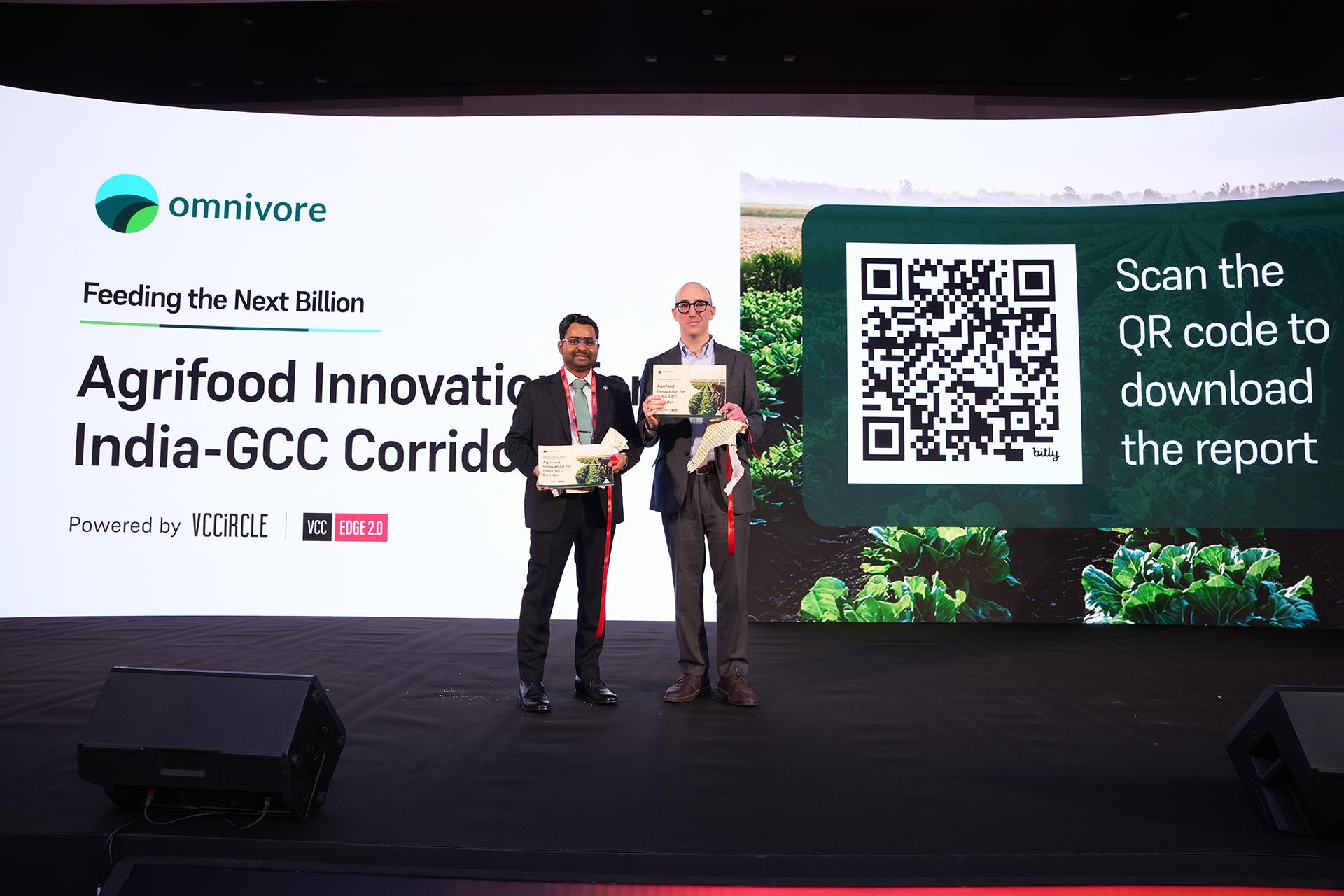
At a time when Gulf nations are accelerating efforts to build climate-resilient and innovation-led food systems, agrifood venture capital firm Omnivore — in partnership with VCCircle — launched its latest whitepaper, Feeding the Next Billion: Agrifood Innovation for the India–GCC Corridor, at the VCCircle Limited Partners Summit Dubai 2025.
The report, unveiled by Mark Kahn, Co-founder & Managing Partner, Omnivore and Anitesh Dharam, Business Head, VCCircle & VCCEdge, underscores the growing urgency to reimagine food security across the Gulf Cooperation Council (GCC) and the increasing relevance of India’s agritech ecosystem in shaping that transformation.
The launch followed a morning of high-level dialogues between LPs, family offices, and institutional investors exploring the evolving Indo-Gulf capital corridor.
Positioning agrifood alongside these themes, the whitepaper argues that food security is now central to long-term economic diversification, climate resilience and political stability in the Gulf. It highlights how Omnivore’s portfolio and sectoral experience in India can serve as a bridge between Indian innovation and GCC priorities, particularly as investors look beyond traditional asset classes towards impact-oriented and climate-aligned strategies.
GCC at a structural turning point on food security
The paper traces how Gulf food-security strategy has shifted over five decades - from large, subsidy-driven attempts at agricultural self-sufficiency to a trade-based model and, more recently, to a coordinated focus on sustainability and technology. While GCC states rank high on global food-security indices, they continue to import the bulk of their food requirements, leaving them exposed to geopolitical disruptions, climate shocks in supplier countries and logistics bottlenecks.
With populations rising and diets shifting towards higher-protein, higher-value foods, the Gulf’s existing model of “buying” food security from global markets faces growing strain. National visions across the UAE, Saudi Arabia, Oman, Qatar, Bahrain and Kuwait now frame food security as a strategic objective on par with infrastructure and energy, with a clear push towards local production where feasible and smarter management of import dependence.
India’s agrifood innovation engine
Against this backdrop, the whitepaper positions India and Omnivore as a natural partner for the GCC. India combines scale - over 130 million farmers and highly diverse agro-climatic zones - with a rapidly expanding agritech and climate-tech startup ecosystem, while Omnivore brings over a decade long experience of operating in this ecosystem and delivering market-level returns.
As the ecosystem grows from a niche cluster of early- and growth-stage ventures to now working across precision agriculture, biological inputs, post-harvest infrastructure, digital marketplaces and rural fintech, it presents immense opportunities for collaboration and expansion across geographies. Omnivore, which has backed over 40 startups since 2011, sits at the centre of this landscape.
Three collaboration pathways: Trade, Technology, Talent
The whitepaper outlines three key ways India and the GCC can work together.
Trade: Strengthening India–GCC food flows through more efficient, tech-enabled supply chains and traceable export systems.
Technology: Deploying proven Indian agritech solutions to enhance local farming, controlled-environment agriculture and food production across the Gulf.
Talent: Enabling GCC agrifood startups to scale faster by leveraging India’s deep technical talent, R&D capabilities and cost-efficient manufacturing base.
Omnivore’s proposed fund and the road ahead
The whitepaper also introduces Omnivore Agrifood & Rural Resilience Fund (OARRF), which is intended to support startups that can operate across India and selected GCC markets. The fund will focus on ventures that strengthen food security (reliable access to safe, nutritious food), agricultural prosperity (higher and more stable farmer and rural incomes), and resource efficiency (more productive use of land, water, and energy in food systems).
As Gulf investors deepen their exposure to India and Indian capital increasingly looks westward, agrifood could emerge as a defining theme of the next phase of the corridor. The whitepaper frames this not just as a commercial opportunity, but as a shared regional project of building a more secure, more resilient food system for the next billion consumers spread across India and the GCC.
To download and read the full whitepaper, click here
No VCCircle journalist was involved in the creation/production of this content.